Desert Rain Again Cedric Alexander and Gold Dust
Gold Dust in Arizona's Washes
How and Where to Find Gold in The Desert
Text and Photos by Lee Allen
A curt history lesson, please. A million years ago, rocks melted, the earth cracked, and gold nuggets formed. End of course.
A meg years later on, the nuggets are hard to find, but weekend prospectors search the desert wadis (washes), hoping to get lucky.
"Gilt is not going to go too far from its source unless there's been lots of time and lots of h2o to wash information technology downhill," says David Steimle, a chapter president of the Gold Prospectors Association of America (GPAA). Standing recently in a wadi at the foot of Arizona's Santa Rita Mountains, he said, "Overflowing waters thousands of years ago washed nuggets down the mountain through these arroyos and deposited the golden flakes we're looking for today. Prospectors who have worked these gullies know they don't produce a lot of sizable chunks, but they practice give up a bunch of fine aureate dust."
Steimle walks Arizona's wadis, poking and prodding the dry creek beds as well as mountain arroyos and mineral-rich sand, looking for aureate nonetheless hiding in placer beds. "Placer deposits occasionally run for miles along a stream," he says. "Some spots get scratched and discovered, others are still undetected later on all these years."
 In fact, a big percentage of the world'due south gilt deposits are yet undiscovered despite human'southward efforts to locate pockets of the precious metal. "Streams and their tributaries that catamenia across aureate-bearing areas are likely to behave traces of the precious metal," says Diane Bane of the Arizona Department of Mines and Mineral Resources. "Where gold has been found in the by is the best identify to seek it today."
Gold was start reported about one hundred and twenty v years ago, near where Steimle stood, in what proved to be the largest and richest placer deposit in the southeastern corner of the state. In fact, Arizona'south placer mining industry had its official beginning with the discovery of gold along the flanks of the nearby Quijotoa Mountains. From 1875 to 1880, several hundred miners and their companion burros worked an area from the ix thousand four hundred foot Old Baldy Peak to lower meridian claims. Their efforts produced about fifteen thou dollars in gold each year. The hardest working miners each took out nearly one ounce of aureate per day. At that time information technology was valued at seventeen dollars.
Once the richer gravels had been worked over, commercial mining concluded. But weekend prospectors began to appear, seeking what their earlier counterparts might have missed.
 Placer gold is still found in almost all southwestern deserts, according to onetime Agency of Mines engineer George Fansett. "Moving water has been the most potent gene in the formation of placer deposits," he says. "The usual practice is to seek gold by panning along the water courses—stream beds, sand confined, gulches and arroyos. All areas that look as though a slowing down or slackening of water current occurred are worthy of closer exam since gold, beingness heavier than most materials, tends to settle and sink to bedrock. Depressions may hold rich pockets of gold while bedrock that is fissured and shattered, acting as riffles, also holds good potential," he says. The potential also as the dreams, success and frustration is reflected in the names of some mining claims: "Great Promise," "Maybe, Perchance Not," "Wishful Thinking," "One More Time," "Easy To Become," "Endeavour Your Luck," "Claret Blister" and "Big Bruiser."
"Many men accept attempted to brand a living reworking old placer ground," says Fansett. "If the ground has non been worked over many times and the bottom of the wash not carefully searched, a painstaking cleaning of crevices and potholes may yield lucrative results."
Lucrative is an ill-defined discussion here. GPAA member Judy Miller has searched for gold in these stream beds using both dry out- and moisture-wash methods. "I've been doing this for about 4 years," she says. "I've had success, but based on what I take home after each trip, I'm non however ready to retire." Further downstream from where Miller digs, sifts and pans, fellow society member Mike Rebholz chews on an unlit cigar as he swishes water in his greenish plastic pan. "I'll tell you what," he says with a grin, "information technology'due south not the Mother Lode, merely for this spot, it own't bad. There's color in the pan, and if we could do that every pan full, past the cease of the day it would be worthwhile. Nosotros'd accept a pile big enough to see without a magnifying glass. It'southward fun though, that's the primary thing." Fun and a few flakes are what it's all about to well-nigh participants.

"A lot of us take a selection and a pan along on every outdoor jaunt," says Steimle. "I have no get-rich-quick fantasies. In that location are days when some flakes show up and others when the pan keeps coming up empty. Information technology's the chase that'south most heady, knowing the next shovel load or upturned rock could produce flakes or even a small-scale nugget. Not that finding something doesn't make your centre crush faster, but I relish the hunt every bit much as I relish whatsoever discovery.."
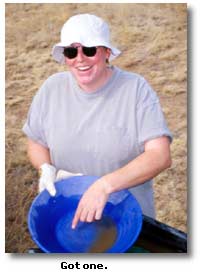 "You're not going to get rich mining golden," says New Mexico geologist Dave Salars. He uses gold panning every bit an excuse to be outdoors, "kind of like going fishing without baiting your hook," and he's not besides concerned about bringing home gold dust equally long every bit the activity itself offers fresh air and sunshine. "I make more money some weekends at swap meets, buying bargains and re-selling the stuff," he says, chuckling, "only I do savour the exercise, camaraderie and the search for buried treasure." He's found some, likewise, in the Pinos Altos Mountains of New Mexico. "I found a chunk of pyrite material with a rice-sized piece of gold inside. Information technology made my heart beat faster, and I got the aureate bug actually bad," he remembers.
That was vii years – and a lot of unsuccessful trips – ago. Salars, at present club president of the 2 hundred and fifty-member Desert Gold Diggers, Inc., is quick to caution, "Yous don't do this to go rich. You learn real fast why gilt is worth and so much, because information technology's difficult to detect and hard work to recover. You lot've got to examine a lot of sand earlier yous're successful."
Weekend gold seekers need to understand that experience is the all-time instructor, and it takes practice in the field to gather that experience. "Some folks go out and buy a agglomeration of equipment similar metallic detectors, thinking 'I'm going to go rich this weekend,'" Salars says. "2 years later, they've used the equipment twice and information technology'southward for sale—sort of like the do machines bought with good intentions that end upwardly as expensive apparel hangers."
Salars likes placer mining because of its nickname, "Poor Man's Mining," which implies that required supplies are minimal. "You don't need much in the style of capital investment or equipment," he says. A bones panning kit should include an inexpensive 14-inch plastic pan with molded washboard-type riffle insets, a small mitt shovel, a rock hammer, a sturdy long-bladed screwdriver or pry-bar, a whisk broom, tweezers and a sniffer bottle. The sniffer is used to suction the small flakes out of the pan. (Larger nuggets may exist picked out by hand for instant gratification!)
Just equally there is no complete and correct equipment list, there is no right way to conduct a easily-on search for the shiny metal. If you're lucky enough to live in an area where the elements provide standing or slowly moving shallow water, yous've just eliminated the need to bring your own. If not, the choice is to carry water to the dig site, keeping in mind that one gallon weighs viii pounds, and some of the liquid needs to be saved for drinking.
To pan for gold, gather a handful of gravel and put it in your pan (preferably a green, cherry-red or bluish pan to reverberate the glint of any elusive gilt flakes). Pick out the larger pieces of rock and clay. Cascade h2o into the pan, swishing it around to separate gravel from clay. Tilt the pan slightly (ten-degree bending, riffle end down), assuasive heavier materials to settle in the bottom. Eyeball the activity constantly looking for blackness sand, red silicate garnets or gold. When the elusive gold flash-in-the-pan does appear (detect the optimistic "when," non "if"), use your sucker bottle or tweezers to remove the flake or nugget.
While "painfully rare" describes the chances of a lucrative "strike" occurring on a weekend outing, "medium rare" often describes the sunburn new prospectors may acquire. "Wear a wide-brimmed hat, employ plenty of sunscreen and drink lots of water," says Salars. "Keep an middle out for critters—two-legged, four-legged and 8-legged. Tell someone where y'all plan to be and when you expect to render. And bring a friend. The buddy arrangement isn't just for swimming."

Golden dust
Enjoy the upshot and keep expectations to a minimum. "There is no advantage greater than that of fresh air and exercise and, if aught else, amateur prospectors are sure to observe enough of both."
Related DesertUSA Pages
- How to Plough Your Smartphone into a Survival Tool
- 26 Tips for Surviving in the Desert
- Death by GPS
- 7 Smartphone Apps to Improve Your Camping Experience
- Maps Parks and More than
- Desert Survival Skills
- How to Keep Water ice Common cold in the Desert
- Desert Rocks, Minerals & Geology Index
- Preparing an Emergency Survival Kit
- Get the Best Hotel and Motel Rates
Share this page on Facebook:
DesertUSA Newsletter -- We transport articles on hiking, camping and places to explore, as well as animals, wildflower reports, plant information and much more than. Sign upwardly below or read more than well-nigh the DesertUSA newsletter here. (Information technology's Free.)
The Desert Environment
The Due north American Deserts
Desert Geological Terms

Source: https://www.desertusa.com/desert-arizona/gold-in-arizona.html

Post a Comment for "Desert Rain Again Cedric Alexander and Gold Dust"